Wall Squats for Health!

James Carter
| 15-10-2026
 · News team
Improving cardiovascular health does not always require lengthy workouts or complicated fitness equipment. Isometric exercises, including wall squats and planks, offer a practical way to strengthen muscles while potentially supporting healthier blood pressure.
Research suggests that even a relatively small weekly commitment may help preserve improvements achieved through regular training. However, the duration and frequency of exercise matter, and occasional workouts should not be considered a replacement for established hypertension treatment.
How Isometric Exercise Works
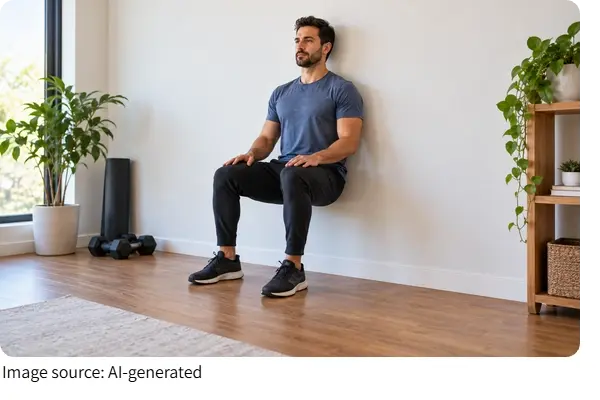
Isometric exercise involves contracting muscles while maintaining a stationary position. Unlike conventional squats, which repeatedly move the body up and down, a wall squat requires holding a seated-like position against a wall. A plank similarly engages the abdominal muscles, shoulders, and other stabilizing muscles while the body remains supported in a fixed position.
Can a potassium-rich DASH diet support heart health? See why medication users should seek medical advice!
How Artificial Intelligence Supports Dental Imaging, Diagnostic Assessment, and Treatment Planning
A Medical Guide to Effective Brushing, Cavity Prevention, and Healthy Teeth and Gums
Evidence-Based Nutrition, Personalized Treatment, and Sustainable Health Management
How Physical Therapy and Targeted Strength Training Help Older People Improve Balance, Mobility, and Independence
Understand hypertension symptoms, risk factors, accurate blood pressure monitoring, and effective treatment options
During an isometric hold, the working muscles generate tension without substantial movement at the joints. This creates a distinctive cardiovascular response because contracting muscles temporarily compress nearby blood vessels, increasing resistance to blood flow during the exercise.
With repeated training, the body may develop adaptations that improve blood pressure regulation at rest. Research suggests that isometric training can influence blood vessel function, autonomic nervous system activity, and resting heart rate. Such adaptations may help reduce the pressure required to circulate blood throughout the body.
However, blood pressure can rise temporarily during an intense isometric contraction. Proper technique, appropriate exercise intensity, and controlled breathing are therefore important, particularly for people with existing cardiovascular conditions.
What Research Reveals About Weekly Exercise
A study published in BMJ Open Sport & Exercise Medicine in September 2026 examined whether reducing the frequency of isometric training could preserve improvements in blood pressure. The research involved 100 adults with an average age of 37. Participants initially completed a four-week program consisting of four wall-squat holds per session, with each hold lasting two minutes and separated by two minutes of seated rest.
After the initial training period, participants followed different schedules for another four weeks. Some continued exercising three times weekly, while others reduced their sessions to twice or once per week. Another group stopped training. The researchers reported lower systolic and diastolic blood pressure among participants who completed the initial training program compared with the control group.
Systolic pressure, represented by the upper number in a blood pressure reading, measures the pressure exerted when the heart contracts. Diastolic pressure, the lower number, reflects pressure between heartbeats.
During the second phase, participants who continued exercising generally maintained improvements, with the three-session weekly schedule producing the strongest overall preservation of several cardiovascular measures. Participants who stopped exercising experienced a reversal of some improvements.
The results suggest that once-weekly training may help maintain certain short-term benefits after an initial period of regular exercise. However, the research does not establish that a single weekly session is equally effective for everyone or that the same results will persist over many months. The relatively small sample and short observation period also limit broader conclusions.
Expert Insight
Amanda Paluch, PhD, an associate professor of kinesiology at the University of Massachusetts Amherst and chair of the American Heart Association's Physical Activity Committee, commented on the implications of the research. Paluch stated: “The message is that consistency matters.”
How to Begin Wall Squats and Planks Safely
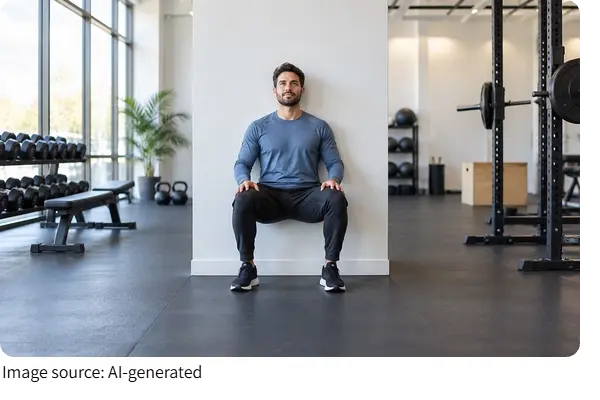
A wall squat can be performed by standing with the back against a sturdy wall, placing the feet slightly forward, and sliding downward into a comfortable partial squat. The position should be held without straining the knees or lower back. Beginners can start with shorter holds before gradually increasing the duration.
For a plank, the body is supported on the forearms and toes, with the torso maintained in a straight line. A modified version with the knees resting on the floor can reduce the difficulty while preserving muscle engagement. Breathing should remain steady throughout each exercise. Holding the breath or straining forcefully can cause sharp temporary increases in blood pressure. Rest periods between holds also allow the body to recover.
People with uncontrolled hypertension, cardiovascular disease, dizziness during exercise, or other significant medical concerns should obtain professional guidance before beginning an intensive isometric program. Exercise should stop if chest discomfort, unusual breathlessness, or lightheadedness develops.
Wall squats and other isometric exercises may help support healthier blood pressure through repeated muscle contractions and cardiovascular adaptations. Recent research suggests that exercising once weekly may preserve some short-term improvements after an initial period of more frequent training, although three sessions per week produced stronger results across several measures.
The most appropriate routine depends on fitness level, health status, and individual tolerance. Regular physical activity, a balanced diet, appropriate medication when prescribed, and routine blood pressure monitoring remain important components of cardiovascular care. For personal medical questions, consult a qualified clinician.